It’s not enough to see a disruptive wave coming on the horizon. If your company catches it too soon, or too late, or it doesn’t crest high enough, you won’t capture enough power to ride to victory. General Magic developed smartphone technology in the 90s, before a sustainable market existed. Borders closed, in large part, because they were late to invest into ebooks and ecommerce that they controlled. And Lytro’s hypothesis that “focus later” camera technology would revolutionize photography never proved true.
Milwaukee Tool tells their success story as one where they deliberately pursued disruptive innovation. That exact phrase appears six times on the history page of their company website. There’s some truth to it – they invested heavily into the lithium-ion cordless power tools that have disrupted corded tools. And there’s no denying the company’s success. In the mid-2000s, when the disruptive wave was just starting, Milwaukee was an also-ran in the power tool industry, with annual revenue around $700 million USD. Buoyed by their focus on cordless tools, they proceeded to rattle off nearly two decades of compounding double-digit annual revenue growth, culminating in revenue of $10.7 billion USD in 2025, and they now sit as arguably the premier power tool manufacturer in the world.
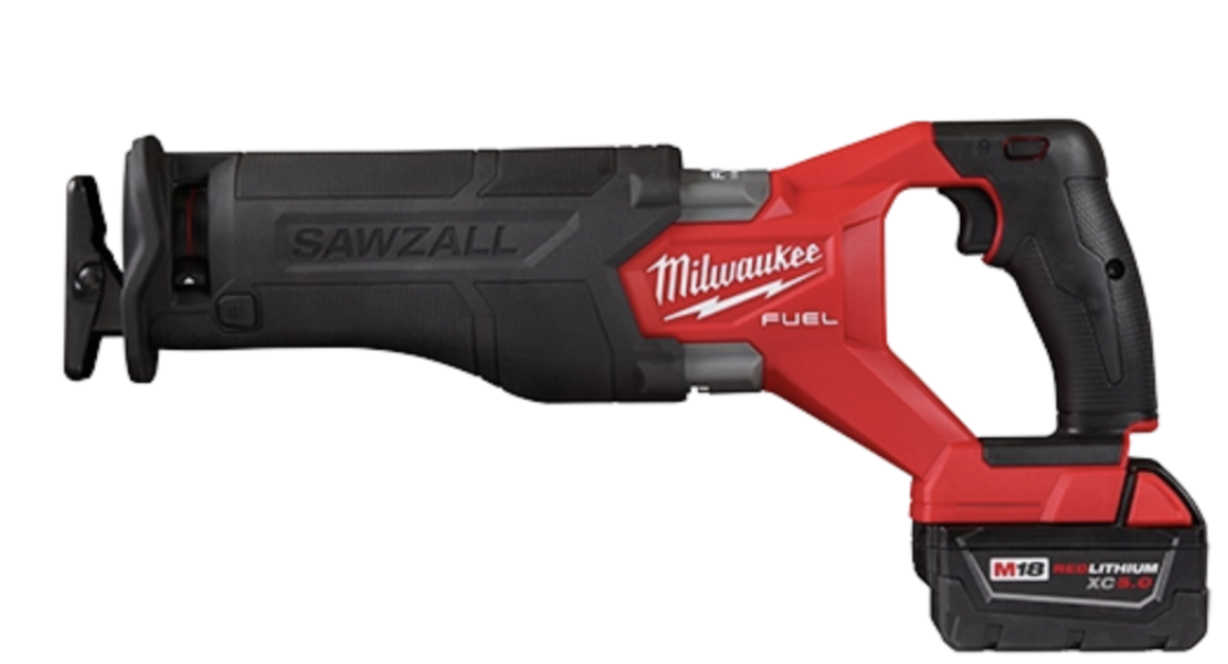
(source: milwaukeetool.com)
Is Milwaukee Tool the rare company that not only saw the wave, but timed it perfectly? Not really! They were still subject to the same laws of physics, the same uncertainty, that dominate all disruptive waves. But that just makes what they actually did all the more interesting. As it turns out, the disruption story is only a small part of their hidden superpower, one that lives between the cracks of all the choices that they made.
We Talkin Bout Practice Disruption?
Disruptive innovation describes a phenomenon that Clayton Christensen documented in his 1997 book The Innovator’s Dilemma, where an incumbent in a large market is relegated to the dust bin of history by a new technology that grows inside of a smaller or less desirable market. Once the incumbent realizes that the new technology competes with its own, it’s too late to catch up to the advantages that the upstart firm has accumulated with the new technology. The purest version of disruption looks like this:



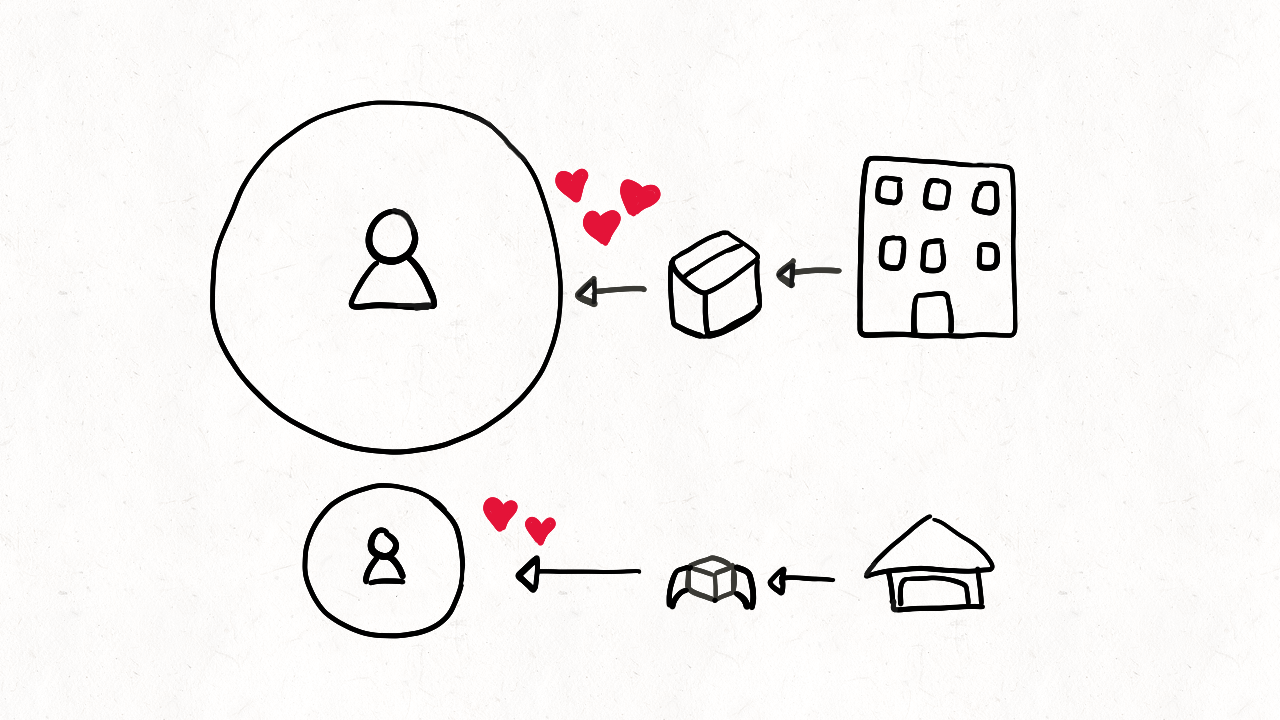
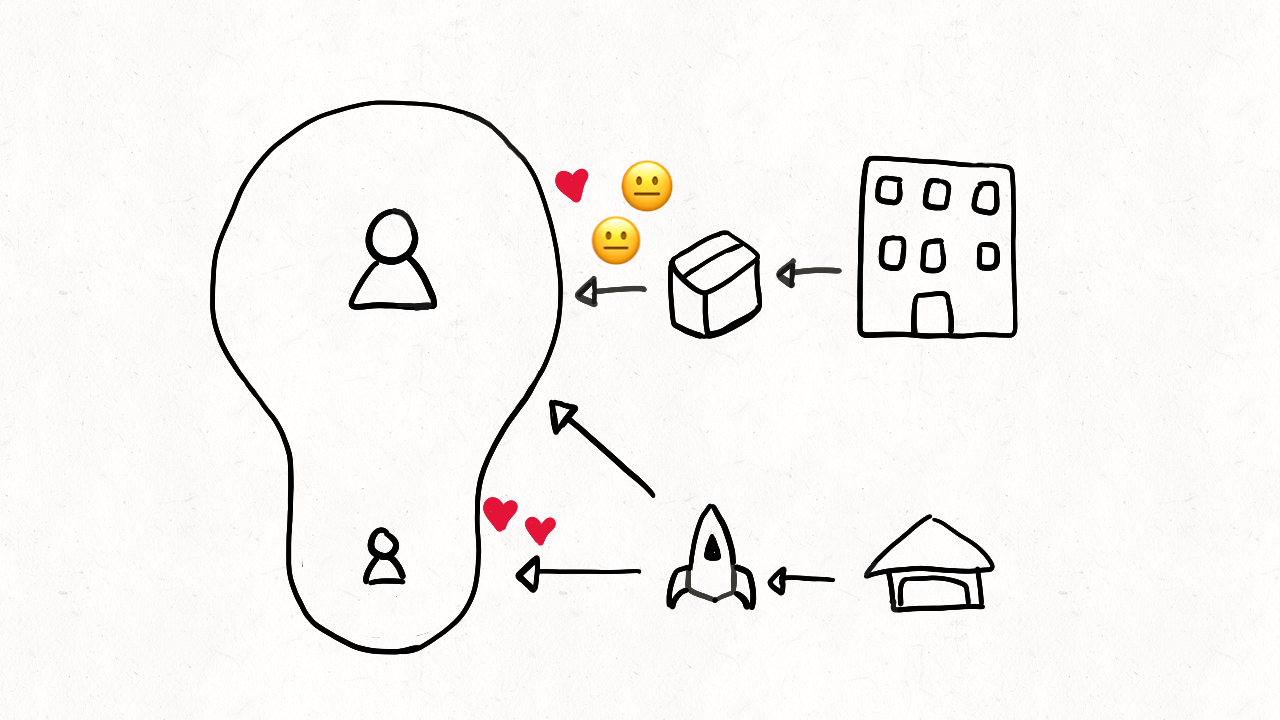
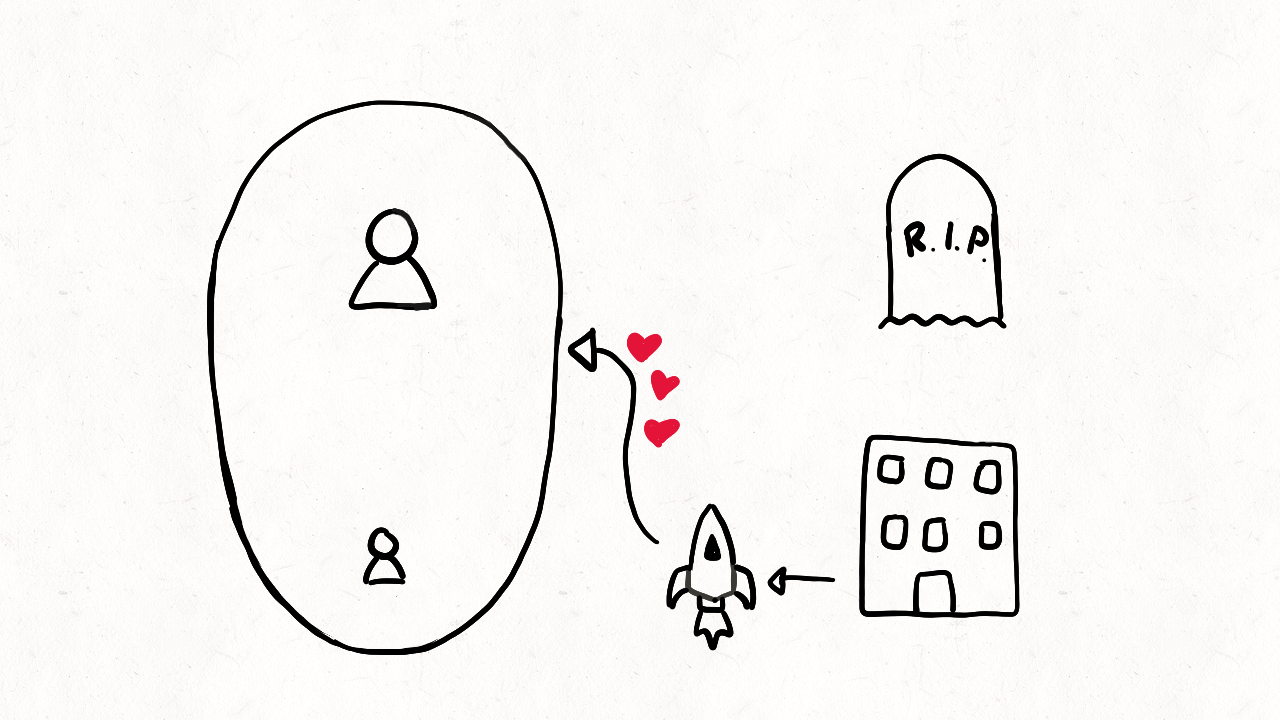
Disruptive innovation is like Fight Club: the first rule is that you can’t talk about it. This is because neither market has customers that want to listen. The upstart’s customers, perfectly content with the status quo, don’t want to hear about how the upstart would love to solve some other, larger market’s needs. And the new technology is worse for the incumbent market for the foreseeable future. In fact, this uncertainty creates a temporary moat for the upstart. So, instead of proclaiming the disruptive end of physical media, iTunes and the iPod launched as companions to a library of CDs. And Best Buy didn’t even wade into digital music until late in 2006, five years after Apple began disrupting part of their core business1.
Instead, companies tend to use the word “disruption” by its dictionary definition of “a big change to the status quo”. Jeff Bezos, who operationalized Christensen’s theory by growing Amazon inside the market for “books that Barnes and Noble won’t have in stock”, used the word in this generic way in 2011: “if you’re going to invent, you’re going to disrupt”. Sometimes, “disruption” means “a magic solution”, such as when Nokia CEO Stephen Elop, in the midst of being disrupted by Android/iOS, declared “There are other mobile ecosystems. We will disrupt them”. Disruption isn’t an incorrect word in this quote, it’s just different from Clayton Christensen’s theory. It’s easy to see why! A textbook accurate use would be much, much worse:
“There are other mobile platforms. We’re going to… well, first we have to acquire or create a different platform that serves a smaller market really well. Then, over the course of… uh, who knows? Years? Decades? That blessed tiny market will grow to consume Apple’s and Google’s markets! Team on three! 1-2-3!!”
There’s no guarantee that such a market even exists, and even less of a guarantee that the technology that serves it will eventually outperform incumbents in the larger market. No, real disruptive innovation has too much uncertainty to talk about publicly2. So what about Milwaukee Tool, who talks about it all the time?
TTI’s Cordless Power Tool Prescience
Like most power tool brands, Milwaukee Tool is not an independent company. Rather, they are part of Techtronic Industries, a Hong Kong based conglomerate commonly called TTI. Horst Pudwill, a German national, moved to Hong Kong in the early 1970s as an engineer working for Volkswagen. In 1985, he and cofounder Roy Chi Ping Chung created TTI as an OEM supplier manufacturing cordless power tools for US brands like Craftsman and cordless vacuums for brands such as Bissell. Pudwill believed that cordless power tools, at the time a “gimmick”, would come to replace corded tools, and he also feared that the brands he supplied would threaten his margin as time went along. So, in the 2000s, he went on a vertical integration buying spree, acquiring established floor care and power tool brands such as Dirt Devil, Hoover, and Ryobi. TTI purchased a struggling Milwaukee Tool in 2004 for $627 million USD, a meager ~1x revenue at the time3.
In the early 2000s, cordless power tools primarily used nickel-cadmium batteries, whose performance suffered from short runtimes and inconsistent power output. Lithium-ion cells promised to solve those issues, but only if someone could mitigate the safety and reliability issues inherent to Li-ion’s energy-dense chemistry. In 2005, the same year they were acquired, Milwaukee cracked the code and released the V28 battery line, the first lithium-ion professional tools capable of surviving in the harsh conditions of a job site.
Milwaukee continued improving their Lithium-ion technology, launching the M12 and M18 battery and tool lines in 2008. TTI leveraged that same technology in its other power tool brands, most prominently in their neon green rebrand of homeowner-focused Ryobi in 2007. In 2012, power tool companies, including Milwaukee, launched brushless electric motors, which offered further efficiency and power gains. And by 2015, cordless power tool performance began to match corded tool counterparts, validating Horst Pudwill’s decades-prior intuition. Milwaukee then set their sights on replacing heavier-duty corded tools.
Milwaukee’s history corroborates the words on their website: they intentionally focused on catching a disruptive wave with cordless tools. They invested in an uncertain technology at the expense of other technologies. Speaking in a 2023 earnings call, TTI CEO Joseph Galli, Jr reminisced about their 2000s strategy:
17 years ago, Horst Pudwill and I sat down and developed the strategy for TTI. We agreed on two things. We said, “We’re going to have the very best people in the history of power tools, and we are going to dominate cordless. We’re going to be obsessively focused with cordless. We will no longer waste money, spend money on corded tools or petrol or hydraulic or pneumatic.” We said, “Our cordless won’t just be a battery like NiCad or nickel metal hydride. We will have advanced technology here.” Now, when I went out and started communicating this to the investment community, people laughed at us [emphasis added]. They said, “Wait a minute. Cordless, it’s only 40% of the market. Your competitors are still they’re developing or buying petrol companies. They still have a lot of corded. There’s all kinds of hydraulic pneumatic products.” We got hammered for this because people said, “You’re only looking at 40% of the market.” We always said, “Well, that’s just like telling Steve Jobs when he launched iPhone, ‘Wait a minute. Why aren’t you doing payphones and fax machines?’” But nobody really listened to us then [emphasis added]. But, Horst, I think we’re getting people’s attention now.
But two facts complicate the simple version of history, where Milwaukee succeeded by skating to where the disruptive puck was heading. First, Milwaukee was not the only power tool manufacturer researching lithium-ion. In fact, Bosch launched the first ever lithium-ion power tool, a small non-professional grade screwdriver called the Ixo, back in 2003 — two years before Milwaukee’s lithium-ion batteries went on sale. DeWalt, 4x the size of Milwaukee and the clear power tool market leader at the time, launched their own 36V line in 2006. Both brands exist today; both manufacture their own cordless tools whose technology rivals Milwaukee’s. Second, and more importantly, a careful reader will notice that Milwaukee’s run of double digit growth ran for nearly a decade before battery technology disrupted corded tools. If Milwaukee’s growth didn’t stem from technical dominance built while intentionally disrupting corded power tools, what explains their sustained success?
Pranab Sachi, founder of Attention Copilot, talks about how a person holds many competing wants. If you imagine these wants as two dimensional vectors, personal coherence looks like aligning these arrows so they point in the same direction.


Companies act as a collective version of this, with competing wants distributed across its members. John from Marketing might care about the customer, but he may care even more about a potential promotion. Good strategic choices reduce the magnitude of conflict between these wants, and possibly even remove the conflict altogether. In some organizations, John’s promotion will depend on playing internal political games; in others, it will depend on his ability to serve customers. Milwaukee Tool has done a remarkable job of aligning the wants across its many layers, creating a coherent organization that outcompetes its rivals.
Milwaukee’s Strategic Choices
TTI’s acquisition of Milwaukee Tool was part of Horst Pudwill’s strategy to focus on cordless equipment. On the power tool side of the business — which contributes the vast majority of TTI’s revenue — Ryobi serves consumers, while Milwaukee serves professionals. The brands operate independently, complementing each other in the market and benefitting from shared battery technology. The wants of the brands do not conflict. In contrast, Dewalt’s parent company Stanley Black & Decker went on their own buying spree in 2010. As of 2018, the company was still trying to “manage the cannibalization” between brands like Dewalt, Craftsman, Porter & Cable, and Irwin and Lennox.
In January 2007, TTI hired Steve Richman as President of Milwaukee Tool. Richman started his career at Black & Decker, later became the President of the Bosch-Skil North America Power Tool company, and briefly worked in adjacent industries prior to his start at Milwaukee. The team he inherited included the skilled engineers making lithium-ion battery breakthroughs and almost no marketing department. Richman brings up Clayton Christensen in nearly every interview; he’s the direct source of half the mentions of “disruptive innovation” on Milwaukee’s website.
Imagine that you’re in Richman’s position for a second. You have a brand that is many times smaller than market leaders like Dewalt, and you have a slight technological edge that could be competed away at any moment. You’ve studied Christensen’s theory, but you aren’t a tiny upstart. You still need to make your $700 million USD numbers every year, and you can’t know when your cordless tools will disrupt corded ones. Remember, it took 30 years for Horst Puwdill’s prediction to come true! What should you do? Christensen’s theory of disruptive innovation is usually discussed in the context of the technology involved, but if you invert that perspective, as Richman seems to have done, it’s also a theory about searching for the right market for the technology you currently have.
In 2007, cordless tools were less powerful, more expensive, and significantly less convenient for long tasks than their corded counterparts. Richman’s most important strategic choice4 focused Milwaukee on the Mechanical, Electrical, and Plumbing trades (MEP), where those things did not matter. The general construction workers that DeWalt and Bosch served earned relatively low wages while pushing table saws and hammer drills to their limits for hours on end. In contrast, an electrician commands higher rates and uses their power tools for fewer, more precise tasks in tight spaces where cords get in the way. These tradesmen were already a part of Milwaukee’s user base, and they were happy to pay a premium for the convenience that cordless tools provided to their workflows. Richman applied the theory of disruptive innovation by choosing this smaller market that Milwaukee could already serve with their newly created lithium-ion battery technology.
Good strategic choices require making tradeoffs — otherwise everyone else would just copy the move. Above, Galli talked about ignoring the 60% of the market that preferred corded tools. This wasn’t just talk. Milwaukee built tools for MEP tradesmen instead of tools that served the larger, general construction market. As Contractor supply noted in 2012:
One key to Milwaukee’s new product launches, as it has been in the last few years, is that you will not find any miter saws, planers or other woodshop-type tools in the lineup. Milwaukee continues to focus on designated core user groups of electrical, mechanical, plumbing, HVAC and MRO contractors (with some application drift into builders and remodelers) with virtually all of its new offerings. Yes, some new products have crossover applications, but Milwaukee’s top targets are clearly bullseyed for all to see.
Milwaukee’s choice to serve this market aligned neatly with TTI’s larger cordless tool strategy, and another of Richman’s choices oriented the company’s product development process towards the customers in that market. He frequently says that Milwaukee is not a power tool company but a solutions company. From many companies, this statement would land as hollow corporate speak, but Milwaukee backs it up with their actions. They built what they call a “belly to belly” system of product innovation, with the “largest user-facing Jobsite Solutions team in the industry”, where their product management team spends about half their time in the field with real users. Onboarding includes actual construction projects. Many power tool companies employ sales reps that cover multiple stores inside a territory. Milwaukee employs reps that spend 8 hours a day in a single Home Depot. These are costly time and personnel investments that only make sense if they generate products that really solve user needs. And, again proving the rule that good choices should have a tradeoff, Milwaukee is willing to take risks on products that don’t make perfect sense on paper. The Toolguyd blog recounted this anecdote in 2024:
Years ago, while waiting on a food line at a media event, Milwaukee Tool’s Steven Richman told me they didn’t expect to sell a lot of their fluorescent light bulb testers. Why would they launch such a product? It was something their users needed.
Milwaukee gets these products to market quickly. The power tool industry typically works in 18-24 month project cycles; Milwaukee can get to market in half that time. Part of the reason is that Richman and his team fostered a high ownership culture, where employees are empowered to make decisions and expected to take accountability for their results. Management is expected to be candid about company direction and to deal with setbacks with support instead of pointing fingers. It’s usually difficult to make decisions in large companies. Information has to flow up and down the organization, and many stakeholders must be satisfied. All the time invested next to its users aligns Milwaukee employees’ internal wants with those of their customers… so Milwaukee trusts their employees’ judgment… so they get products to market faster… with improved odds that those products will be commercially successful.
Outside the Milwaukee-specific loop, TTI diffuses capabilities across their brands. Ryobi, Hoover, Oreck, and Dirt Devil all benefited from Milwaukee’s battery breakthroughs. And Milwaukee leveraged resources from these brands as well. In 2001, Horst Pudwill personally negotiated an exclusive distribution agreement with Home Depot for the Ryobi brand, spurring its growth. That relationship later expanded to include Milwaukee Tool, who turned the power tool section of their stores into a “sea of red”, displacing competitors and flooding the aisles with their sales reps.
As Milwaukee’s product success feeds back into the company coffers, they spend money to increase their capabilities. Throughout the 2010s, they invested millions into R\&D centers in Brookfield, Wisconsin and Chicago, Illinois. TTI as a whole spent 4.4% of revenue on R\&D expenditures in 20245. Competitors Makita and Stanley Black & Decker spent about half of that percentage. The innovation system is a virtuous cycle, whose results justify further investment.
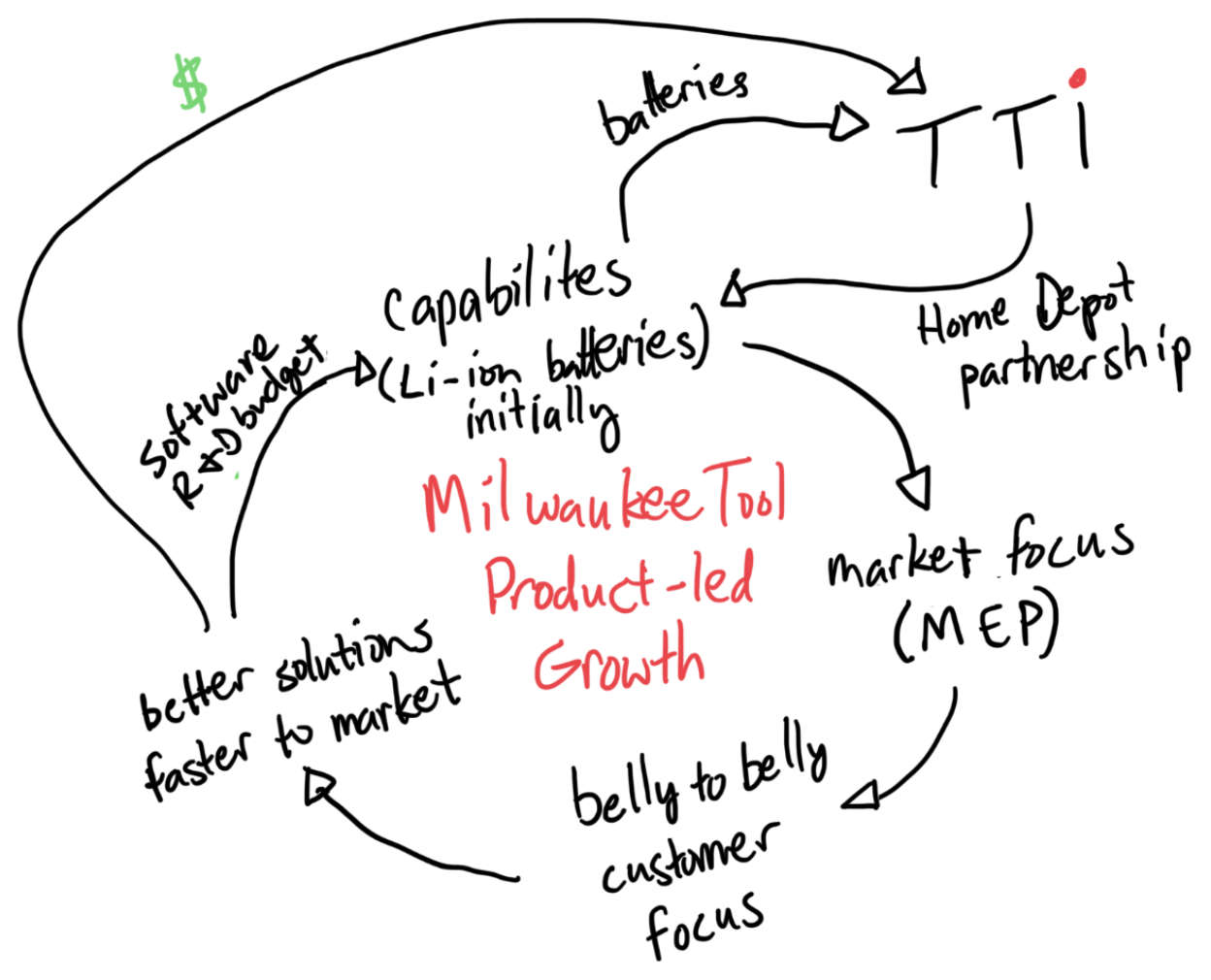
Disruptive innovation is an uncertain endeavor, and Milwaukee’s product development system works because it does not rely on it at all. Rather, Milwaukee has produced products via many types of innovation over the years.
How Coherence Wins
What does it look like for Milwaukee to win in the marketplace? Unlike many of the cases in The Innovator’s Dilemma, the power tool industry remains competitive, even after cordless disruption. Dewalt and Bosch, for example, both grew revenue in absolute dollars during this century. Milwaukee grew faster, stealing bits of market share from competitors large and small, and capturing a much larger share of the growth of the overall market. Reviewing Milwaukee’s entire portfolio would be a massive undertaking, but the following three examples highlight a few of the ways that Milwaukee innovated.
Milwaukee’s PACKOUT line of modular storage and Dewalt’s equivalent ToughSystem are essentially big plastic containers. But because Milwaukee built theirs to serve tradesmen that need to switch configurations throughout the day, and because they are able to launch products at such a rapid pace, Milwaukee’s system stands out for being easier to reconfigure and offering far more SKUs. There was no disruptive technology here, just savvy category expansion fueled by Milwaukee’s speed to market and deep focus on their customer. Other similar category expansions include hand tools and protective equipment.
In the mid 2010s, Milwaukee built a software team to develop their ONE-KEY connected tool system, which can track inventory and control tool functions over Bluetooth. At the time, most competitors contracted out their software expertise6, but Milwaukee invested in an in-house group to ensure that they formed a “cohesive product suite”. ONE-KEY launched in 2015, beating Bosch’s similar offering to market by months and Dewalt’s by several years. True to Milwaukee’s market focus, ONE-KEY is differentiated by its free app that offers trade-specific reporting. The Bluetooth technology migrated from the cell phone industry, but again this isn’t an example of Christensen-style disruption. The existing solutions that ONE-KEY displaced included aftermarket RFID tags, ad hoc Excel spreadsheets, or plain old pen and paper. Unlike the typical disruption story, Milwaukee’s solution was immediately superior to the alternatives.
Sometimes strategic innovation just looks like stability, such as with Milwaukee’s 12V and 18V battery systems. Their tools today use the same “slide pack” interface that has worked since the launch in 2008.7 Dewalt and Bosch were both forced to rethink their battery systems in the 2010s. Dewalt relaunched their system in 2011 because they originally designed their lithium-ion packs for the less ergonomic “pistol-style” batteries required by legacy nickel-cadium cells. Bosch initially invested into a massive 36V battery line that was necessary for their heavy-duty users. As smaller 18V performance caught up to their 36V counterparts, Bosch refocused on 18V cells in 2018. The coherence of Milwaukee’s strategy looks like foresight: they invested into customers who didn’t need older or bigger batteries8, leaving them in a great position to acquire new users as performance improved.
The “final boss” heuristic for a strategy is the moat. Strategic choices should make it difficult for others to squeeze your margin. Milwaukee counter positioned themselves with their MEP trade focus. Dewalt declined to solve light bulb testing issues, instead concentrating on the much larger woodworking segment that they controlled. Milwaukee’s battery platform created switching costs for users — costs they have been happy to pay since Milwaukee continues to increase the value of being locked into their system. Milwaukee’s consistent annual growth brought them scale economies to rival their initially-much-larger competitors. They hold patents9 on their inventions, and the exclusive partnership they formed with Home Depot makes life difficult for competitors. The relentless focus on spending time with the user has created intense brand affinity; they routinely top lists of most loved power tool brands.
But the process power of their innovation system might be their greatest advantage. Milwaukee Tool inherited TTI’s vision of a cordless future. They chose a market segment where they could thrive as that uncertain future came to fruition. They brought on the right people to fulfill that vision and made strategic choices with real trade offs, investing financial capital and talent capital in the right places. None of the individual choices look all that clever. “At TTI, we’re good at making batteries so we should acquire companies with cordless tool expertise”. Sure. “At Milwaukee, we should focus on the subset of the market that likes cordless tools already”. Makes sense. “We should spend a lot of time with our users”. Yeah, ok. “If we can trust our people to make good decisions, we can get to market faster”. Duh? But in the real world, building all those choices into an integrated system that works is exceedingly difficult. It’s why Michael Porter talks about the power of “mutually reinforcing fit of activities”, or Roger Martin describes strategy as “integrated choices”, or why Richard Rumelt’s strategy kernel must have “coherent actions”.
Like everyone else, Milwaukee can’t talk directly about Christensen-style disruption, and they use the word as a rallying cry to bring positive change for their users. Their growth largely stems from reliably delivering non-disruptive innovations year after year. Where they’ve practiced disruptive innovation, they’ve done so in a clever and selective way, capturing upside from the cordless tool revolution while avoiding the downsides of its uncertain timeline. Broad organizational coherence, their real superpower, provides an advantage that’s difficult to copy, hidden in the sum of all the choices that they have made.
In 2024, Joseph Galli Jr. abruptly stepped down as CEO of TTI, Inc10. TTI promoted Steve Richman in his place. Horst Pudwill remains the company’s chairman. It’s unclear what technology will disrupt the power tool status quo next, or whether Milwaukee’s product development system will continue to thrive as their current leadership begins to pass the torch. But their multi-decade run of success stands as an example of the power of strategic coherence. Companies, and the customers they serve, are collections of personalities big and small, each with their own dreams and ambitions. Since 2005, Milwaukee has aligned the wants of all those people better than anyone else in the power tool world.
-
CDs did not comprise a large percentage of revenue for Best Buy, but they did pull people into the store, where they purchased other, more profitable merchandise. ↩
-
Unless you’re talking to venture investors, who thrive on backing uncertain technologies or markets that produce rare but high upside outcomes. ↩
-
The conglomerates that own power tool brands typically combine numbers in their financial reports, so exact financial data is rarely available. ↩
-
Milwaukee’s Canadian website dates the trades focus to 2005, before Richman was hired. However, most sources, such as this 2025 earnings call, credit Richman with creating the strategy. ↩
-
Consumer focused companies tend to spend ~2% of sales on R\&D. SharkNinja spends a whopping 6-7% on it, which explains how they launch so many new products each year. ↩
-
As of 2025, most power tool brands seem to have internal software teams, but this wasn’t true in ~2015. ↩
-
Ryobi, for its part, sells ONE+ batteries that work with tools they launched back in 1996 ↩
-
Milwaukee has continued to support the 28V tool lines that launched before Steve Richman joined, but the 12V and 18V lines are much larger parts of the business ↩
-
To be fair, every power tool manufacturer files patents of their own, and creatively works around their competitors’s patents. A comprehensive review of each company’s patent portfolio may or may net out to a Milwaukee advantage. ↩
-
In 2026, Galli was named the CEO of TTI competitor Chervon. Drama! ↩