This year, Chicago Bulls fans enter the season with justified optimism (instead of our typical delusional optimism) for the first time since Derrick Rose’s knee gave out in 2012. In the 21st century, 18 of the 30 NBA teams have reached the NBA Finals at least once. The Bulls, despite their sixth-ranked operating income, are one of the 12 teams that have not. Money should convey a team-building advantage, so fans blame management for the lackluster results. Gar Forman and John Paxson, Bulls executives from 2003 until 2020, were fired after years of a grass roots #fireGarPax fan movement. Team President Michael Reinsdorf, son of owner Jerry Reinsdorf, hired Artūras Karnišovas to replace them. “AK” ushered in six years of consistent mediocrity, where the Bulls sat in no man’s land: too bad to compete for a title and too good to secure top-tier talent via the draft lottery. Karnišovas was let go after the 2025-26 season.
Many Bulls fans believe the true fault lies at the top with the Reinsdorf family, questioning both their willingness to invest in the team and their hiring judgment. But who knows? Maybe this time they’ve learned from past mistakes and are poised to bring in the executive team that turns things around?
Hope springs eternal, and the Bulls’ latest front office reset comes buoyed by a stroke of luck. The Bulls, with only the 9th best odds in the NBA lottery, moved up during the drawing, receiving the 4th pick in a draft with exactly four players who have superstar potential. They selected Caleb Wilson from UNC. His NBA Summer League performance generated, um, shall we say… enthusiastic reviews from the NBA media [warning: NSFW language].
The man who selected Wilson was new Bulls Executive Vice President Bryson Graham. Michael Reindsorf says he hired Graham because of his talent evaluation skill. While working in New Orleans, the Pelicans’ front office indeed found very good players late in the draft, including Trey Murphy III and Herb Jones in 2021, taken with the 17th and 25th picks, respectively. And the Atlanta Hawks became a surprise 6-seed in the 2026 playoffs, right after Graham joined the team in 2025. Clearly, the man knows how to spot talent. But don’t take my word for it, just listen to what veteran Bulls beat writer Sam Smith has to say:
It’s obviously difficult to truly know who is responsible for what draft pick or transaction when that person is not the final decision maker, and Graham wasn’t until now.
Oh, ok. No concrete decision-making track record. Got it. Smith continues:
Though there’s been a consistency to the type of players that have been drafted when he’s been head of scouting and the draft in Atlanta and New Orleans. They’ve primarily involved a profile that Graham has a acronym for, SLAP: Size, Length, Athleticism, Physicality. They’ve been 6-7 and 6-8 two-way players like Herb Jones, Trey Murphy, Dyson Daniels and Nickel Alexander-Walker, three of the four selected outside the Lottery.
As Graham reiterates this SLAP philosophy in the introductory press conference that Smith is covering, my grizzled Bulls-fan-klaxon begins to sound. Because SLAP fails a basic test: the opposite of a strategic choice should not be stupid on its face. There are no NBA teams building a roster full of tiny, short-armed, slow guys who are afraid of contact. Everyone likes big, athletic players who are good at both offense and defense. It’s like touting a BIG stock investment strategy — Bargains, Increasing value, Goes up always — both acronyms are as redundant as they are vacuous.
To be fair, we could steelman SLAP and make it into a real strategic choice. We would just need to avoid players who are good at basketball but lack this particular physical makeup. In fact, one could argue that Atlanta, while Graham was with the team, did that by trading Trae Young (an All-Star caliber player who is low on SLAP) to the Washington Wizards. The problem is that this stronger form of the SLAP philosophy would also reject NBA superstars like Tyrese Halliburton, Nikola Jokic, Jalen Brunson, Luka Doncic, and Steph Curry. To recap, the taken-at-face-value version of this strategy is meaningless, and the strong version eliminates 4 of the top 11 players1 in the Ringer’s top 100 player list. Color me skeptical of SLAP.
A brief aside
Passing the “opposite test” does not, by itself, make a strategic choice into a good one. Karnišovas pursued a strategy of trading for underperforming lottery picks a year before they were eligible for rookie extensions, presumably hoping to find second-contract bargains like Indiana did with Obi Toppin in 2024. This choice, and its opposite, were both defensible. Karnišovas believed his insight was that lottery picks who disappointed for three years just needed a change of scenery. Unfortunately, this belief was flawed. It turns out that past disappointing performance is a pretty good predictor of future disappointing performance.
Judging by the rest of his offseason moves, Graham truly believes in his strategy. The Bulls entered the free agency period with $54 million in salary cap space. Graham offered that space to teams looking to get rid of bad contracts (in exchange for draft picks), but he found no takers2. So, the Bulls pivoted, signing free agents Nic Claxton and Norm Powell and showing interest in acquiring Bennedict Mathurin via a sign-and-trade. And earlier, with the 15th pick in this year’s draft, they selected Dailyn Swain, a wing from the University of Texas3. All four fit the SLAP profile.
Perhaps they’re using more sophisticated analyses behind closed doors, but I’m not impressed with the apparent simplicity by which the new front office evaluates talent. You can defend all of these moves in a vacuum, but it’s hard to imagine them adding up to a championship contender. Neither was I encouraged by the dissonance between the Bulls’ claim that they wanted to acquire draft assets and their draft-night actions, where they sold their two second rounds picks for cash. The Bulls have employed this cost-cutting maneuver4 so frequently that a well-known Bulls podcast named themselves after it. Meanwhile, the best-run teams are making roster moves that sabotage their rivals’ financial flexibility and draft capital, competing on a level I’m not sure the Bulls are even aware of.
All told, I haven’t seen anything that tells me the decision-making of this regime is an improvement over any of the others that have crippled the Bulls in the past two decades. I fear that SLAP will join the list of previous clever-sounding (but poor) Bulls strategies, alongside Karnišovas’s incoherent “building while competing” and John Paxson’s need to “build equity within the organization for future decisions”.
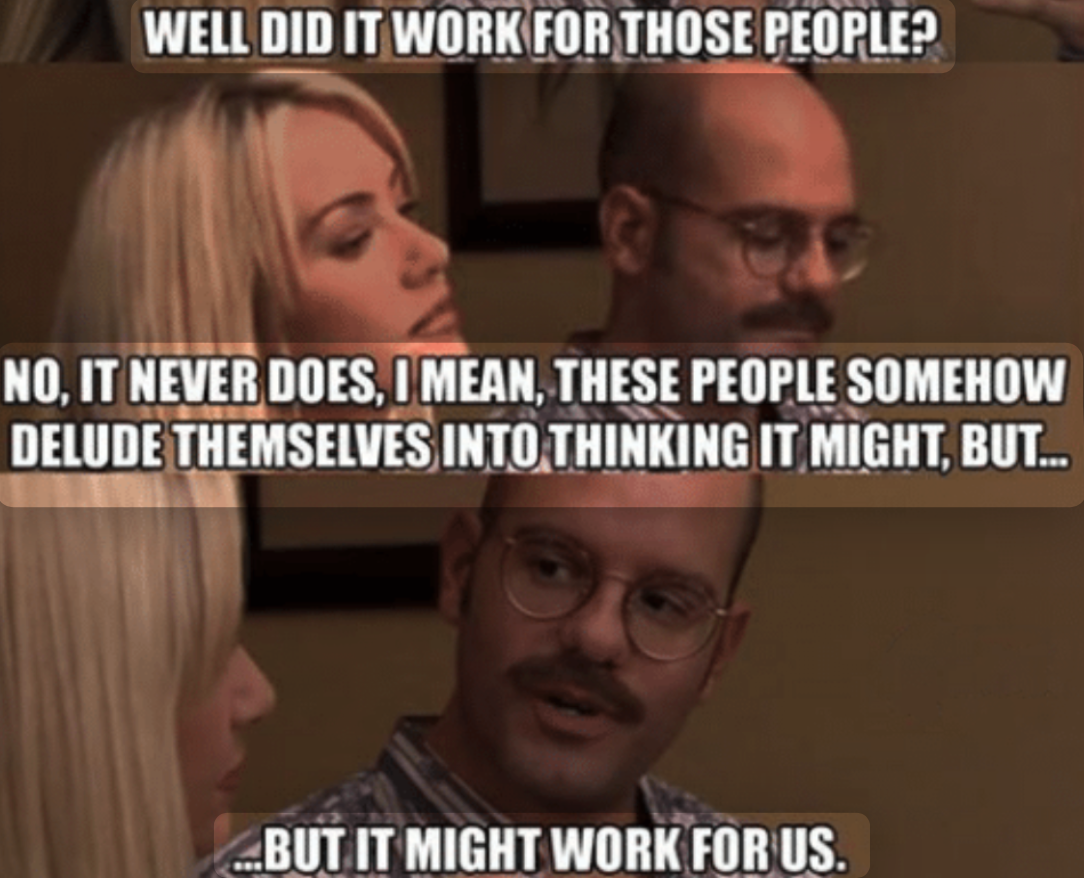
And yet, maybe it won’t matter. The most difficult part of building a championship level roster is acquiring a top 10 player. And the most common way to acquire such a player is… dumb luck. Of the SLAP-less superstars from earlier, only two were taken with a top 10 draft pick. Two weren’t even drafted until the second round! No one knows how to predict who will become a star. We only have to think back to the aforementioned Derrick Rose era, when the Bulls lucked into the number one overall draft pick and quickly built a contender. If Caleb Wilson reaches the zenith of his potential, then Graham can put any acronym he wants on the scouting whiteboard. At least, that’s what I’m telling myself. Even the most justifiable optimism benefits from a swig of delusion to wash it down.
-
At the time of writing, Tyrese Halliburton did not appear on the list because he missed all of last season with an injury ↩
-
A good idea, but unfortunately executed a few years too late. Managers make fewer contract mistakes these days, and teams have learned to avoid attaching draft picks in salary dumps. ↩
-
Swain shot an abysmal 13% in Summer League action, prompting jokes about shifting to a SLAPS strategy, with “Shooting” as the trailing “S” ↩
-
Remember, the Bulls have the 6th highest operating income. They’re based in the 3rd largest market in the U.S. They do not need to recoup $2 million by giving up draft assets. ↩