Strategy is one of those rare principles with broad consensus across many domains. To illustrate, we only need to look at a couple of videos from the Harvard Business Review’s YouTube channel:
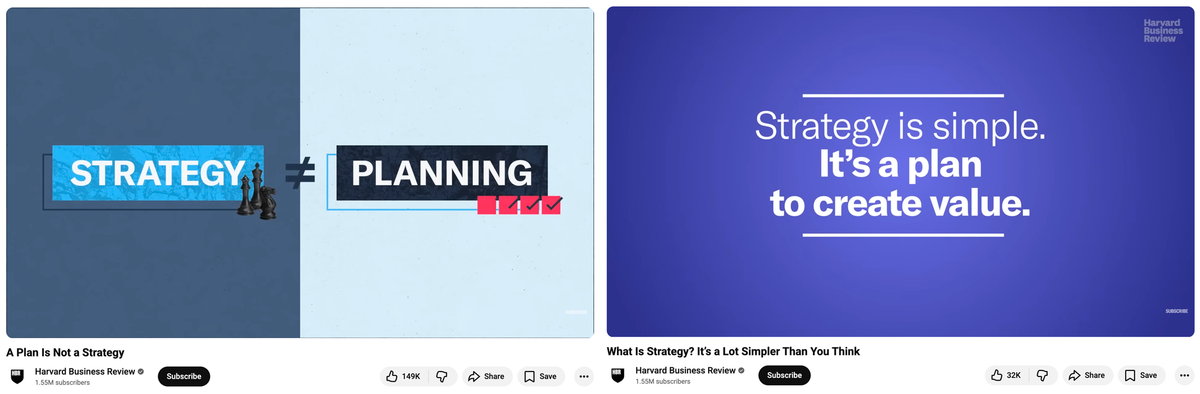
Just kidding! There are hundreds of reasonable definitions for strategy out there. The supplemental materials in Peter Compo’s The Emergent Approach to Strategy includes a list of 75 distinct definitions. The book creates a 76th.
What’s going on here? The problem is that any definition of strategy that applies everywhere is so watered down that it ceases to be useful anywhere. So, people create definitions tailored to a specific domain, and they often slap a label of universality on them.
Playing To Win, in Brief
Here is Roger Martin’s definition, from his book Playing to Win:
Strategy is an integrated set of choices that uniquely positions the firm in its industry so as to create sustainable advantage and superior value relative to the competition.
I contend this leaves little room for poor strategies, or strategies for actors which aren’t firms. So it’s not a universal definition of strategy. That doesn’t mean it’s not a useful definition where it applies, of course. But for my own pedantic satisfaction, the definition I accept without reservations is:
[An effective] [overarching] strategy [for a business] [has] an integrated set of choices etc etc etc
I admit: this is much less punchy. And it’s not unreasonable to expect the reader to implicitly understand that the definition applies to Martin’s domain. It does matter, though. Martin’s expertise lies in diagnosing and effecting change in large and mature organizations. Playing to Win is written for this audience. Not all of the advice will apply as neatly to a small startup or to someone trying to strategize within a small section of a company or to someone looking for a strategy to spend more time with their family1.
This isn’t the only place I have an internal semantic debate with Martin. He describes strategy creation as a heuristic, not an algorithm. His definitions of those words are:
There are many definitions of heuristic, but the one I use is an approach to problem solving that aids progress toward a solution but does not guarantee the solution will be as desired … algorithms: a formula for getting the desired answer
I struggle with this because Playing to Win has a very clear procedure for strategy creation which, to me, looks a lot like a formula. You could reasonably describe its approach as a nondeterministic algorithm whose individual steps rely on heuristics. Does this undermine the theory? It doesn’t, but let’s hold that thought for a bit.
Playing to Win’s core ideas are expressed as a playbook with three components:
- A strategic choice cascade. This is a set of five questions that a strategy must answer:
- What is your winning aspiration?
- Where will you play?
- How will you win?
- What capabilities must be in place?
- What management systems must be in place?
- A strategy logic flow that evaluates where to play choices
- A process he calls reverse engineering that a team uses to evaluate different where to play / how to win choices.
Martin calls the where to play / how to win combination the heart of strategy, and most of the playbook is designed to support getting this part right.
There is a lot packed into each item within that scaffolding. For example, he builds off Michael Porter’s work with an activity system diagram intended to identify an integrated and mutually reinforcing set of capabilities, one of Porter’s hallmarks for competitive advantage. And there are a host of good heuristics for evaluating strategies such as “There are many ways the higher-order aspiration of a company can be expressed. As a rule of thumb, though, start with people (consumers and customers) rather than money (stock price).” Reverse engineering is underpinned by a very cool idea to evaluate strategic choices by asking “What would have to be true to make this a good choice?”
But I’m not going dive into the details of the playbook because I want to spend time elsewhere in Martin’s ideascape. Most strategy books are a mix of theory and case studies which support the theories by demonstrating them in the real world. Playing to Win is no exception, and the majority of the cases revolve around Martin’s time building strategy practices at Procter & Gamble. I’ve worked at large consumer facing companies analogous to P&G; but I never worked in leadership at one. And I’ve never been a CEO creating a company’s overarching strategy. So while the structure of Playing to Win’s playbook appears sound to me, and many of the hueristics interesting, most of the cases didn’t resonate for me…
…that is until last third of the book, where one of the cases really grabbed my attention. It wasn’t the structure or framework that fascinated me. And it wasn’t even the specifics of the case itself. It was something deeper and, to me, more profound about the way Martin approaches his work. And as I’ve continued to read and listen to Martin, I’ve become more and more impressed.
The Killer Case
Playing to Win’s chapter on management systems took me by complete surprise. It walks through the changes Martin and A.G. Lafley (P&G’s former CEO) made within P&G as they aspired to think more strategically as an organization. I was expecting further diagrams, bulleted lists, or metrics templates. But Martin describes something… softer:
Unfortunately, the management teams had been trained over decades to see strategy reviews as anything but an opportunity to share ideas. Traditionally, it had been their job to build an unimpeachable plan and to defend it to the death.
…
The culture-busting kickers were threefold. First, there would be no presentation, only a discussion of the strategic issues agreed on in advance. Second, we limited the number of folks in the room, down from twenty-five to just four or five from the business plus the CEO and the corporate leaders who would bring specific experience or knowledge on the strategy issue. Third, participants would not be allowed to bring more than three new pages of material to the meeting to share—we did not want the participants to race off and create yet another PowerPoint deck with answers to the questions raised in the letter. We genuinely wanted to have a conversation about the key strategic issues in the business.
…
These reviews focused on very basic, very fundamental questions with the intent of helping the team make better strategic choices. The group would spend three or four hours chewing on the few critical issues together. We had three reasons for the shift in process. First, we wanted to shift the culture of the organization to one that was more dialogue oriented. Second, we wanted to create a structure in which the business teams could truly benefit from the experience and cross-enterprise perspective of senior leaders. And finally, we wanted to build the strategic-thinking capabilities of P&G’s executives, asking them to practice thinking through strategic issues with others in real time.
Martin focused on convincing his colleagues that it was safe to collaborate with their managers on strategic issues. He fostered a culture rather than imposing and enforcing accountability. Yes, he did this via clear and tangible rules and systems, but it’s remarkably charitable and empowering towards the leaders he was working with.
The most interesting question to me from Playing to Win is “How did Martin figure out how to unlock P&G’s leadership team?” Much like crafting a strategy, I don’t think there’s a single neat answer. But Martin is a prolific writer and podcast guest. He’s left a wealth of evidence from which to search for further clues.
Wait, Where Does That Come From?
First of all, Martin didn’t start from scratch. He’s quick to provide a theoretical foundation for what he built:
In any conversation, organizational or otherwise, people tend to overuse one particular rhetorical tool at the expense of all the others. People’s default mode of communication tends to be advocacy—argumentation in favor or their own conclusions and theories, statements about the truth of their own point of view. To create the kind of strategy dialogue we wanted at P&G, people had to shift from that approach to a very different one. The kind of dialogue we wanted to foster is called assertive inquiry. Built on the work of organizational learning theorist Chris Argyris at Harvard Business School, this approach blends the explicit expression of your own thinking (advocacy) with a sincere exploration of the thinking of others (inquiry). In other words, it means clearly articulating your own ideas and sharing the data and reasoning behind them, while genuinely inquiring into the thoughts and reasoning of your peers.
Second of all, if you listen for it, Martin frequently talks about relinquishing the ownership of ideas. The novel insight that enabled Monitor Company to compete against established strategy consulting firms was to teach their clients how to think strategically for themselves instead of doing strategy for them. Martin echoes this tactic from another case near the end of Playing to Win:
In this moment, the best role of the consultant became clear to me: don’t attempt to convince clients which choice is best; run a process that enables them to convince themselves.
I even see this in Martin’s frustration at our tendency to dismiss each others’ perspectives or his genuine delight at hearing someone else present a novel anecdote adjacent to his talking point.
Lastly, the first article of Martin’s series on how he does strategy includes this line as part of his first step:
Remind Myself of the Inherent Goodness and Fairness of Most People
This seemed out of place to me when I first read it. Business strategy, per Martin’s definition, is about winning. I can’t think of many winning competitors who start their process by reflecting on how great everyone else is. Martin’s first example of this in instructive, though. People will ignore the results of a mediocre strategy because… that’s a fair thing to do! But he also says that, conversely, customers and employees will reward you if you treat them well.
Taken all together it’s possible to imagine how someone who
- Commits to viewing people as good and fair
- Is not possessive of their own knowledge
- Is willing to seek the wisdom in others’ ideas
builds a process, based on someone else’s theory, which empowers mid level managers to embrace Martin’s strategic thinking as something that supports them. To be clear, these traits aren’t a causal explanation for what Martin built at P&G. I can imagine someone who is suspicious of humanity but loves a healthy debate arriving at assertive inquiry2. But I find it fascinating that these “fluffier” traits add up to something that drives real results in a hyper competitive environment. Perhaps Michael Porter would describe these character attributes as mutually reinforcing capabilities. Playing to Win demonstrates that they can create a competitive advantage.
How I Think About Martin
A careful reader might notice that the 4-step procedure in How I Do Strategy only loosely overlaps with the playbook from Playing to Win. And Martin has further strategic wisdom elsewhere not found in either. The case on P&G’s management systems piqued my interest because of how non-universal it is. Not every team will have the battle scars that P&G had. For a looser culture, adding presentations might be more appropriate. Teams lacking rigor in their thinking might need to mandate more preparation, instead of restricting page counts.
Strategy seems to be a fundamentally creative act. Martin’s rules of thumbs, tests, and frameworks are like scales and chords. In practice, a skilled musician understands these pieces as raw materials from which to build. There is an improvisational quality in Playing to Win and Martin’s Medium/Substack.
I started this reflection with my own assertion, that Martin’s “heuristics” were actually “algorithms” in disguise. After studying his actions, I understand better what he means. While Martin offers algorithmic formulas for generating strategies, in practice each time you use them will feel completely different. And by remaining open to inquiry instead of dismissing the theory outright at the first sign of contradiction, I’ve gained a deeper appreciation for the character traits that underpin Martin’s work, things like: productive curiosity, a charitable kindness towards strangers, and non self-centered confidence.
Integrative thinking is one of Martin’s other ideas, where great leaders see two options that seem mutually exclusive and find a third path to integrate parts of each. Assertive inquiry is one clear example of this. Competing fiercely while fervently believing in the goodness of people appears to be another. It’s not a coincidence that I read “curiosity”, “kindness”, and “confidence” in between the lines of Martin’s work. They resonate with how I want to show up in the world. What I enjoyed most about Playing to Win was its clear example that these aren’t mutually exclusive from success.
Thanks to my friend Eric for the hours of conversation by text and phone that helped clarify and influence how I interpret Martin’s thinking.